
A brake caliper uses hydraulic pressure to press brake pads against the rotor and slow the wheel. Its piston and seals control pressure and release, slide pins or opposing pistons keep clamping even, and its mounting bracket and hardware hold everything in place. Sticking pins, leaking seals, or seized pistons can cause pulling, uneven wear, overheating, and soft brakes.
Every time you ease off the gas at a red light on Jamboree or brake hard when traffic bunches up on the 405, a small, tough assembly at each wheel does the heavy lifting. That assembly is the brake caliper, and it turns a light push of your foot into thousands of pounds of clamping force in a fraction of a second.
Most drivers never think about it until something feels off: the car pulls left, the pedal goes soft, or a wheel smells hot after a short drive. By then, one small part inside the brake caliper has usually been struggling for a while.
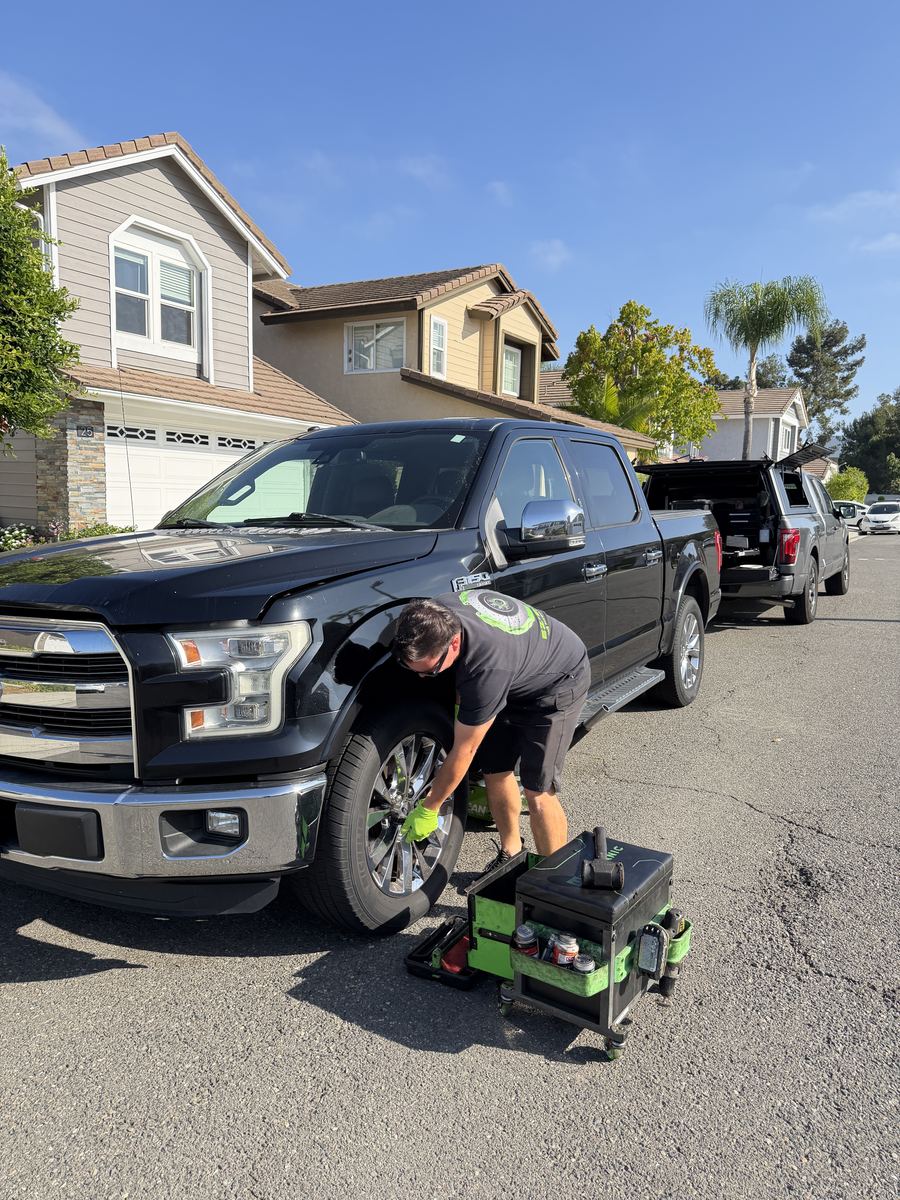
At Ez-Brakes, our ASE-trained technicians bring over 50 years of combined brake experience, and since 2018 we've serviced cars in driveways and office lots from Irvine to Huntington Beach and San Clemente. We take apart a brake caliper almost every day. That hands-on time is why we wrote this guide: we want you to understand what's happening behind your wheels, so you can spot problems early and ask the right questions about any repair.
In this guide, you'll learn:
- What a brake caliper is and where it sits in your disc brake system
- Each part inside the brake caliper and what it does
- How those parts work together, step by step, during a stop
- The difference between floating and fixed calipers
- Warning signs of a failing brake caliper and how to keep yours healthy
Let's start with the basics.
What Is a Brake Caliper? Its Role in the Disc Brake System
A brake caliper is the clamp of your disc brake system. It straddles the brake rotor (the flat metal disc that spins with your wheel) and holds a pair of brake pads, one on each side. When you press the brake pedal, the brake caliper squeezes those pads against the rotor. The friction slows the rotor, and because the rotor is bolted to the wheel hub, it slows the wheel too.
Nearly every modern passenger car uses disc brakes on the front axle, and most now use them in the rear as well. That means your vehicle likely has four of these assemblies, one at each wheel. The front ones usually do more of the work, because weight shifts forward when you stop.
The Three Partners: Caliper, Pads and Rotor
It helps to think of the brake caliper as one member of a three-part team:
- The rotor provides the surface that gets gripped. It also absorbs and sheds the heat created by stopping.
- The brake pads supply the friction material. They wear down over time and are designed to be replaced.
- The caliper supplies the force. It converts hydraulic pressure into mechanical clamping force and holds the pads in exact alignment.
If one partner falters, the other two suffer. A seized brake caliper can wear out a new set of pads in a few thousand miles and overheat a rotor until it warps or cracks.
Why the Brake Caliper Relies on Hydraulic Pressure
Your foot can't produce enough force on its own to stop a 4,000-pound SUV from highway speed. The brake system multiplies that force in two stages. First, the pedal lever and the brake booster amplify your input. Second, the hydraulic system multiplies it again.
This works because of Pascal's principle: a change in pressure applied to an enclosed fluid travels undiminished to every part of that fluid. As the University of Central Florida's physics text on Pascal's principle points out, car brakes are the most common hydraulic systems most of us use. Because the piston in each brake caliper is much larger than the piston in the master cylinder, the same fluid pressure produces a far bigger force at the wheel. That's the core reason a gentle press on the pedal can bring a heavy vehicle to a controlled stop.
Brake Caliper Components: A Part-by-Part Breakdown
A brake caliper looks like a single chunk of metal, but it's really a small hydraulic machine with about a dozen parts. Here's what each one does, in roughly the order that fluid and force move through it.
1. Caliper Housing (Caliper Body)
The housing is the main casting, usually made of cast iron or aluminum. It contains one or more cylinder bores where the pistons live, plus the internal passages that carry brake fluid. The housing must stay rigid under enormous pressure; if it flexed, your pedal would feel soft and stopping distances would grow. Aluminum housings save weight, which helps handling, while cast iron is durable and economical.
2. Caliper Mounting Bracket (Anchor Bracket)
On most cars, the brake caliper doesn't bolt directly to the suspension. Instead, a separate bracket bolts to the steering knuckle, and the brake caliper attaches to that bracket. The bracket holds the brake pads in place and takes the twisting force (torque) the pads generate when they grab the spinning rotor. Loose or under-torqued bracket bolts can cause a clunk when you brake, which is why our technicians torque every bolt to the manufacturer's spec.
3. Caliper Piston
The piston is the part that actually moves. When brake fluid pressure builds inside the bore, it pushes the piston outward against the back of the inner brake pad. Pistons are commonly made of steel (often chrome-plated), aluminum, or phenolic resin, a tough composite that limits heat transfer into the fluid. A typical single-piston brake caliper on a sedan has one large piston; performance designs may use four, six or more smaller ones.
4. Piston Seal (Square-Cut Seal)
This rubber ring sits in a groove inside the bore and wraps around the piston. It has two jobs. First, it keeps brake fluid in and air out. Second, it acts as a tiny return spring. When the piston moves out, the seal flexes slightly. When you release the pedal, the seal relaxes and pulls the piston back a fraction of a millimeter. That small "rollback" lets the pads release the rotor without dragging.
The seal also handles automatic adjustment. As pads wear thinner, the piston slides a little further through the seal and settles in a new resting position. That's why a disc brake caliper never needs manual adjustment for pad wear.
5. Dust Boot
The dust boot is a flexible rubber cover between the piston and the housing. It keeps road grime, water and brake dust out of the bore. It's a cheap part with an important job: once a boot tears, moisture reaches the piston, rust forms, and the piston can stick. Here in Orange County, cars parked near the coast in Huntington Beach, Newport Beach and Dana Point face salty air that speeds up that corrosion.
6. Guide Pins (Slide Pins) and Pin Boots
On a floating brake caliper, the housing has to slide sideways a few millimeters every time you brake. Two greased guide pins make that possible. The pins pass through the bracket and are sealed by small rubber boots that hold the grease in and keep dirt out. When the grease dries up or the boots crack, the pins corrode and bind. A brake caliper with seized pins can't center itself, so one pad does most of the work and wears out far faster than the other.
7. Brake Pads and Pad Hardware
Strictly speaking, the pads are a separate service item, but they live inside the brake caliper assembly and neither can work without the other. Each pad has a steel backing plate and a layer of friction material, which may be organic, semi-metallic or ceramic. Most also carry a small metal tab called a wear indicator that squeals when the pad gets thin.
Pad hardware includes abutment clips, anti-rattle springs and shims. These clips let pads slide freely in the bracket while keeping them from vibrating. Skipping new hardware during a pad change is a common shortcut, and it's a frequent cause of noise and uneven wear.
8. Bleeder Screw (Bleeder Valve)
The bleeder screw is a small hollow valve at the top of the brake caliper. Technicians open it to let trapped air and old fluid escape during a brake bleed or fluid flush. Air compresses, unlike fluid, and that's what makes a pedal feel spongy. A seized or snapped bleeder is a common sign of a neglected brake caliper.
9. Brake Hose and Inlet Fitting
A flexible rubber brake hose connects the rigid steel brake line on the car's frame to the caliper. The hose has to flex as the wheel steers and the suspension moves. It attaches through a threaded fitting or a banjo bolt with copper sealing washers. A cracked or internally collapsed hose can trap pressure in the brake caliper, causing it to drag even after you lift your foot off the pedal.
Quick Reference: Brake Caliper Parts and Their Jobs
| Part | Main job | Common failure |
|---|---|---|
| Housing | Holds pistons and fluid passages | Cracks or corrosion (rare) |
| Mounting bracket | Holds pads, absorbs braking torque | Loose bolts, rusted pad seats |
| Piston | Pushes the inner pad onto the rotor | Rust, pitting, sticking |
| Piston seal | Seals fluid, retracts the piston | Hardening, leaks |
| Dust boot | Keeps dirt and water out of the bore | Tears |
| Guide pins | Let the caliper slide and center | Dry grease, seizure |
| Pads and hardware | Provide friction, prevent rattle | Normal wear, missing clips |
| Bleeder screw | Releases air and old fluid | Seizure, breakage |
| Brake hose | Delivers fluid, allows wheel movement | Cracking, internal collapse |
How Brake Caliper Parts Work Together During a Stop
Now let's put the pieces in motion. Here's what happens inside a typical floating brake caliper in the second or so it takes you to slow down from 45 mph on Irvine Center Drive.
- You press the pedal. The pedal lever and the brake booster multiply your foot's force and push a rod into the master cylinder.
- The master cylinder pressurizes the fluid. Pistons inside the master cylinder push brake fluid into the brake lines. In a hard stop, line pressure can climb past 1,000 psi.
- Fluid travels to each wheel. The fluid moves through steel lines and flexible hoses into the brake caliper bore. Because fluid barely compresses, pressure arrives almost instantly.
- The piston moves out. Pressure pushes the caliper piston against the inner brake pad. The piston seal twists slightly as the piston moves.
- The housing slides and pulls the outer pad in. Pressure pushes equally in every direction, so the same force pushes the brake caliper housing the opposite way. Riding on its guide pins, the housing slides inward and draws the outer pad against the other face of the rotor.
- The pads clamp the rotor. Now both pads squeeze the rotor with equal force. The bracket absorbs the twisting load and passes it to the steering knuckle.
- Friction turns motion into heat. The pads and rotor convert your car's kinetic energy into heat. After repeated hard stops, rotor surfaces can reach several hundred degrees Fahrenheit.
- You release the pedal. Fluid pressure drops. The square-cut seal relaxes and pulls the piston back a hair. The pads ease off the rotor, and the wheel spins freely again.
Why Every Brake Caliper Part Has to Pull Its Weight
Notice how each step depends on the one before it. If the guide pins are seized, step 5 fails: the housing can't slide, so only the inner pad clamps and braking power drops on that wheel. If the seal has hardened, step 8 fails: the piston doesn't retract, and the pad drags on the rotor. If air has crept into the fluid, step 3 fails: some of your pedal travel goes into compressing bubbles instead of moving the piston.
That chain reaction is why a single worn part can make the whole brake caliper misbehave, and why a good inspection checks every component, not just pad thickness.
What ABS and Modern Safety Systems Ask of Your Brake Caliper
Anti-lock brakes, stability control and automatic emergency braking all work through the same hardware. When ABS kicks in, it pulses pressure to a brake caliper many times per second to keep the wheel from locking. These systems assume each brake caliper responds quickly and evenly. A sticky piston or a dry slide pin undermines the very technology designed to keep you safe.
Floating vs. Fixed Brake Calipers: What's the Difference?
Not every brake caliper clamps the rotor the same way. There are two main designs, and knowing which one your car uses helps explain how its brakes wear.
Floating (Sliding) Brake Calipers
A floating brake caliper has pistons on the inboard side only, usually one or two. As described above, it uses fluid pressure to push the inner pad and then slides on guide pins to pull the outer pad into contact. You'll find this design on the vast majority of everyday cars, crossovers, minivans and pickups.
- Pros: Compact, lighter, and less expensive to make and replace
- Cons: Depends on clean, lubricated slide pins; more prone to uneven pad wear when the pins stick
Fixed Brake Calipers
A fixed brake caliper bolts rigidly to the knuckle and doesn't move at all. Instead, it has pistons on both sides of the rotor (two, four, six or even more) arranged in opposing pairs. Each side pushes its own pad.
- Pros: More even clamping, stronger and more consistent stopping, better heat management under hard use
- Cons: Heavier and more costly, with more seals to maintain
Fixed designs are common on performance cars, many luxury models and some heavy-duty trucks. If you've seen a brightly painted multi-piston brake caliper behind the wheel of a sports car, it was almost certainly a fixed unit.
Both types rely on the same core parts: pistons, seals, boots, a bleeder and pads. The difference is how they apply the clamping force.
Warning Signs of a Failing Brake Caliper
Because the brake caliper works quietly behind the wheel, its problems tend to show up as changes in how the car feels, sounds or smells. Have a technician take a look if you notice any of these:
- Pulling to one side when braking. A sticking or seized brake caliper on one side brakes harder or softer than the other.
- Uneven pad wear. If the inner pad is much thinner than the outer pad, the slide pins or piston are usually binding.
- A burning smell or a very hot wheel. A dragging brake caliper keeps the pads in contact with the rotor and creates constant heat. The FTC's Auto Repair Basics guide notes that light smoke from a wheel signals a stuck brake, and that the vehicle should be towed rather than driven.
- Fluid leaks. Wet spots on the inside of a wheel or tire, or a dropping fluid level in the reservoir, can mean a failed piston seal or a loose bleeder or hose fitting.
- A soft or spongy pedal. Air or a leak in the system means less pressure reaches the brake caliper.
- Clunking or knocking. Loose bracket bolts or missing pad hardware let parts shift when you brake.
- Lower fuel economy or sluggish acceleration. A dragging brake caliper acts like a light brake applied all the time.
- Squealing or grinding. Often a pad issue, but a stuck brake caliper can wear a pad down to its backing plate fast.
Sticking Brake Caliper vs. Seized Brake Caliper
A sticking caliper releases slowly or only partly; you may only notice it as heat or a slight pull. A seized caliper is stuck in one position, either clamped or released. Either way, a seized brake caliper leaves that wheel with too much or too little braking, and that's a safety issue that shouldn't wait.
Check for Recalls Before You Repair
Brake components sometimes fall under manufacturer recalls. Before paying for repairs, enter your VIN in NHTSA's free recall lookup to see whether a fix is already covered at no cost to you.
Brake Caliper Maintenance: How to Make Yours Last
A well-maintained brake caliper can last 75,000 to 100,000 miles or longer, while a neglected one may need replacement in a fraction of that. These habits make the biggest difference:
- Service the slide pins at every pad change. Pins should be cleaned and coated with high-temperature brake grease made for rubber components. Petroleum grease swells the boots and causes the very sticking it's meant to prevent.
- Flush the brake fluid on schedule. Brake fluid absorbs moisture from the air over time. That water lowers its boiling point and corrodes pistons and bores from the inside. Many manufacturers recommend a flush every two to three years; check your owner's manual.
- Replace pad hardware, not just pads. New clips and shims keep pads sliding freely and keep the brake caliper centered.
- Inspect boots and hoses. Torn dust boots and cracked hoses are cheap fixes when caught early and expensive ones when ignored.
- Torque bolts to spec. Bracket bolts, caliper bolts and lug nuts all have specific torque values. Over- or under-tightening invites noise, vibration and uneven rotor wear.
- Don't ride the brakes. On long downhill stretches, like the grades along Ortega Highway, shift to a lower gear to limit heat buildup in each brake caliper.
Should You Rebuild or Replace a Brake Caliper?
Technicians once routinely rebuilt calipers with new seals and boots. Today, most shops, including ours, install a quality new or remanufactured brake caliper instead. It's usually faster, comes with a warranty, and avoids the risk of reusing a pitted piston or bore. We also recommend replacing calipers in pairs on the same axle when one fails. A matched set helps each brake caliper on that axle apply the same force, so the car stops straight.
Mobile Brake Caliper Repair in Orange County with Ez-Brakes
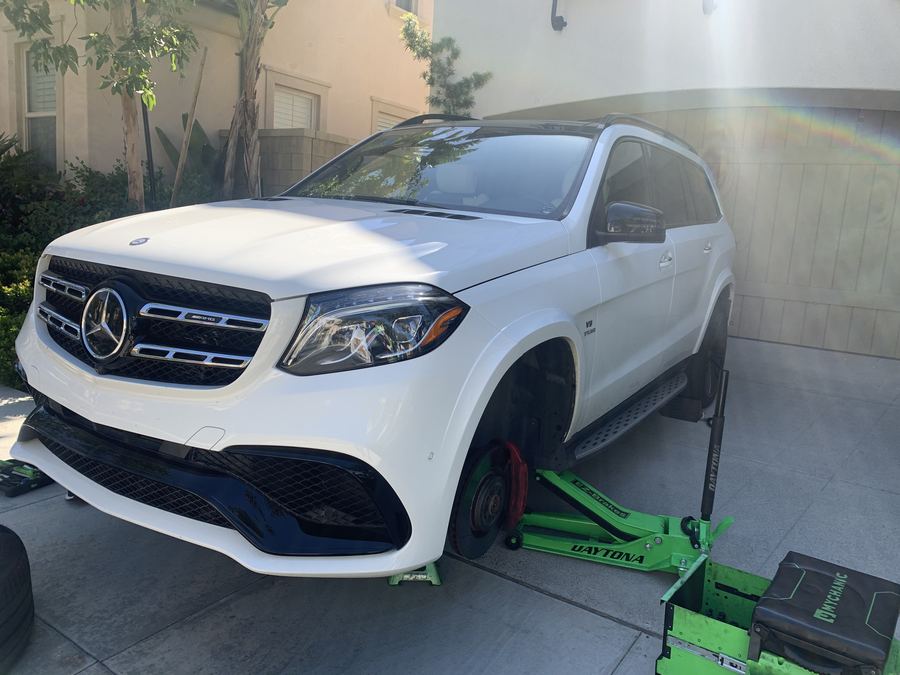
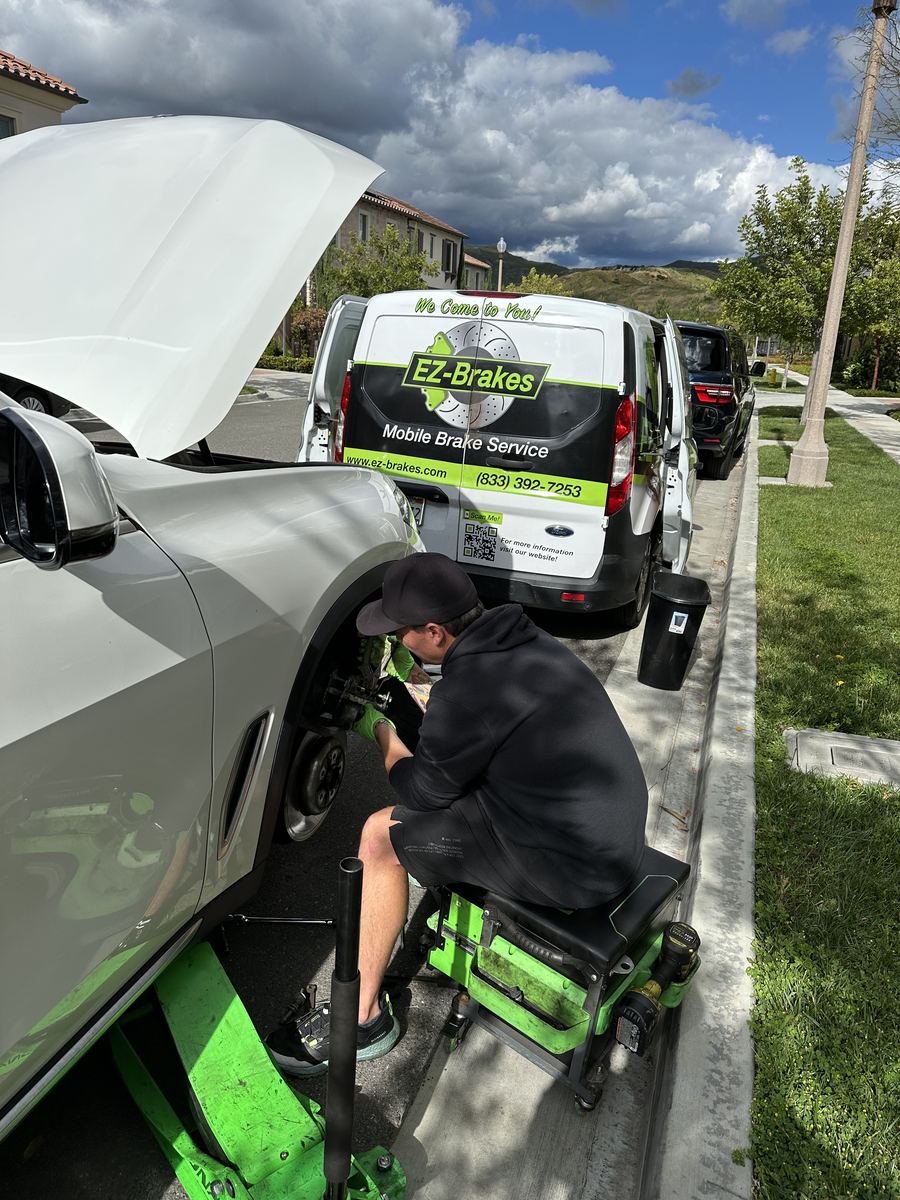
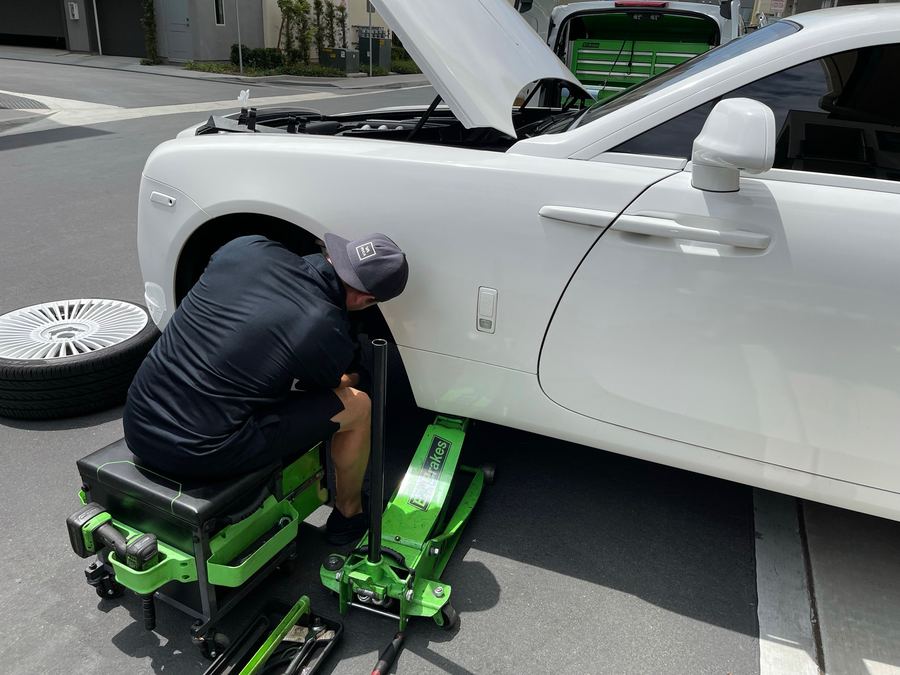
Most brake shops ask you to drop off your car, find a ride and wait for a call. Ez-Brakes works the other way around. Our technicians come to your driveway, office parking lot or roadside, anywhere from Irvine to Huntington Beach to San Clemente, and do the job right in front of you.
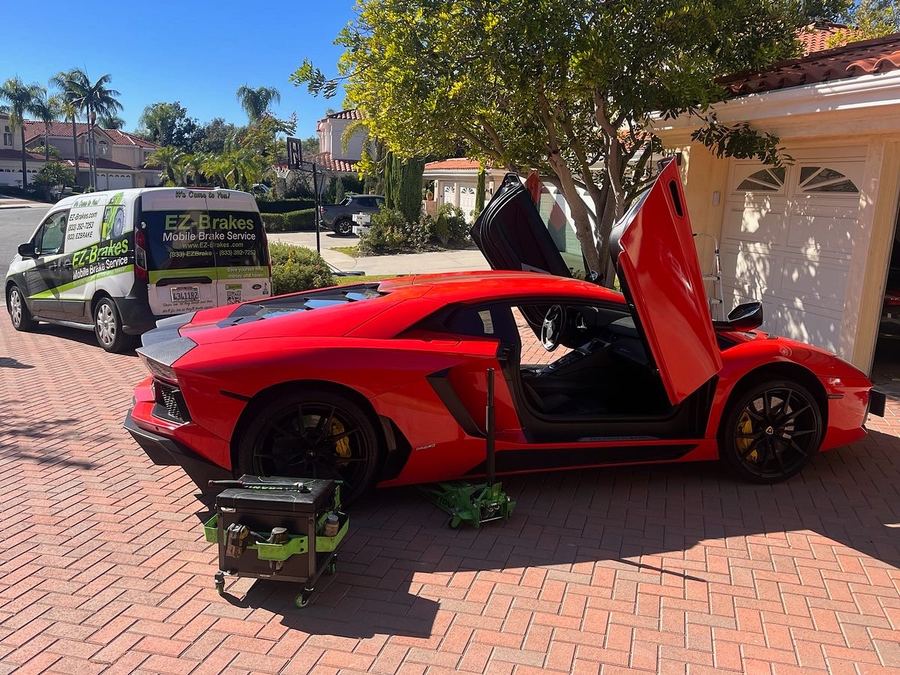
Here's what you can expect when we service a brake caliper:
- A full inspection first. We check pads, rotors, pistons, slide pins, boots, hoses and fluid, then show you what we find.
- Free quotes within 24 hours. You'll know your cost before we start, with no mystery line items.
- ASE-trained technicians. Our team brings over 50 years of combined brake experience.
- Same-day service for most jobs. Urgent issue during business hours? We'll dispatch a tech fast.
- The Green Glove Guarantee. Clean hands, clean tools, clean floors, and no grease left behind on your car.
- 100% satisfaction, in writing. If you're not happy, we'll make it right.
Because we work beside you, you can see the worn pin or leaking seal for yourself. That transparency has earned us strong reviews on Yelp and CARFAX. If you're unsure whether a pull, a smell or a soft pedal points to a bad brake caliper, call (833) 392-7253 and we'll help you sort it out.