
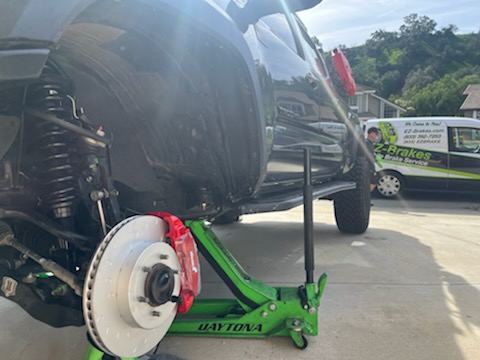
EZ-Brakes replaces worn rotors instead of resurfacing them. Resurfacing made sense decades ago when rotors were built thicker, but modern rotors are engineered thinner to save weight, which leaves little to no safe margin left to cut. A new, full-thickness rotor keeps your safety margin and heat capacity intact, and it's backed by our 12-month, 12,000-mile warranty.
Resurfacing isn't wrong. It's just outdated for most cars on the road today
Resurfacing a rotor means mounting it on a brake lathe and shaving a thin layer off the surface to smooth out grooves or vibration, using the rotor you already have instead of installing a new one. For decades, that was a completely reasonable move. Older rotors were cast thicker, with real margin built in, so a shop could cut one down, put it back into service, and know it still had plenty of material left to safely stop the car.
That's not really the situation most Orange County drivers are in anymore.
Why modern rotors don't leave much room to cut
Every rotor has a minimum safe thickness stamped into it, and federal braking standards require a rotor to stay meaningfully above that minimum even after machining, because cutting too close can measurably increase stopping distance. The problem is that automakers have been making rotors thinner for years, largely to cut vehicle weight and improve fuel economy. Less material was never a problem when rotors just needed to survive daily wear. It becomes a real issue the moment you try to shave more material off with a lathe.
On a lot of newer vehicles, a rotor that looks perfectly resurfaceable is often already close enough to its minimum thickness that a single cut can push it past the safe margin, or leave so little margin that the next pad change requires full replacement anyway.
What resurfacing actually costs you in stopping power
Thickness isn't just a safety-margin number, it's also how a rotor manages heat. A rotor's mass is what absorbs and sheds the heat generated every time you brake. Remove material, and you reduce that capacity. On flat, easy driving that difference might never show up. On repeated hard stops, a loaded vehicle, or a descent like Ortega Highway or the Santiago Canyon grade, a thinner, resurfaced rotor is more prone to heat fade, exactly the moment you need full stopping power the most.
Nicer, high-performance rotors are often built for one use only
This shows up even more on European and performance vehicles. Many higher-end rotors use high-carbon steel or performance-oriented designs that deliver better bite and heat handling, but wear faster and are engineered with almost no machining allowance. Their vane patterns, cooling channels, and surface treatments are also often direction-specific and can't be properly restored by turning. These rotors aren't defective if they can't be resurfaced; they were never designed to be. They're built to perform hard, then get replaced.
| Resurfacing | Replacement | |
|---|---|---|
| Safety margin | Shrinks with every cut, and starts thin on most modern rotors | Starts at full factory thickness |
| Heat handling | Reduced, since less material means less heat capacity | Full original heat capacity |
| Works on high-carbon/performance rotors | Often not possible or not recommended | Always an option |
| Warranty | Typically none on the existing rotor | Backed by EZ-Brakes' 12-month, 12,000-mile warranty |
Not sure if your rotors need replacing? We'll check them honestly as part of every brake job.
Get My Free Quote →So do you actually need new rotors every time?
No, and we won't tell you that you do. If your rotors are still within spec, free of deep grooves, cracking, or warping, they can be reused with new pads. Rotor condition is one of the factors that affects your total brake job cost, and we check it honestly on every visit rather than defaulting to a bigger ticket. When replacement is the right call, it's because it's the safer, longer-lasting option for your specific car, not the only option we offer.